
Power Is Nothing Without Control: Porsche String Alignment and Flat Floor Set Up for GT4, GT3 and Turbo S
Posted by Nick Cook on
Porsche Suspension Upgrades, Redefined
Porsche alignment is about far more than tracking. This is how we use string alignment and our flat floor to set up the GT4, GT3, GT3 RS, GTS and Turbo S for fast road and track, and where Suspension Secrets hardware takes the setup further than the factory parts allow.
Power Is Nothing Without Control
We've spent years making Porsches faster in a straight line. Our calibrations are developed in-house on our hub dyno, and we're proud of the numbers. But horsepower only matters if you can use it, and every bit of it reaches the road through four contact patches roughly the size of your hand.
That's why chassis setup sits right alongside engine tuning at Genome. A correctly set up car puts more of each tyre on the track, more of the time. It turns in when you ask, puts its power down cleanly and stays settled under braking. You go faster because you trust it.

Power is nothing without control.
A proper Porsche alignment brings lap times down, builds confidence and cuts tyre wear on track. For most owners it's the biggest handling improvement they'll ever make, and the one most never have done.
What a Porsche Alignment and Geometry Setup Actually Means
Most people think of alignment as tracking: get the wheels pointing straight and you're done. A performance setup goes much further. It's the combination of every setting that decides how the tyre meets the road.
- Camber is how far the wheel leans in or out when viewed from the front. Negative camber (top of the wheel leaning in) counters body roll and tyre flex, so the tread sits flat on the road when the tyre is loaded in a corner.
- Caster is the backwards tilt of the steering axis when viewed from the side. More caster gives stronger self-centring, better high-speed stability, and adds camber to the outside wheel as you steer, so you need less static camber.
- Toe is whether the wheels point slightly inwards or outwards when viewed from above. Front toe trades turn-in sharpness against straight-line calm. Rear toe-in keeps a mid- or rear-engined car stable on the brakes and on the power. Toe is also the setting that wears tyres fastest when it's wrong.
- Ride height and rake set the centre of gravity and the attitude of the car. A slightly lower nose sharpens turn-in, but only if damper travel and steering geometry are looked after.
- Bump steer is the toe change that happens as the suspension moves. It gets worse when a car is lowered, and it makes the front end feel nervous over bumps and kerbs.
- Corner weights describe how the car's mass is shared between the four tyres. More on that below.
These settings all affect each other. Change the ride height on one corner and you've changed its camber, its toe and the load on the opposite corner. That's why the method matters so much.

Why Not Just Use Porsche's Factory Alignment Settings?
The factory alignment for your car is a sensible compromise. It has to suit every owner, every road surface, every tyre and the tyre warranty. It's also given as a range, and a typical alignment check pulls the spec for your model from a database and adjusts until each reading sits inside that range.
That range is wide. A car can be "in spec" with one side at the top of the window and the other at the bottom, and it'll pull, wear its tyres unevenly and feel different turning left to right. For a daily driver that's acceptable. For a GT4 on Cup 2s, or a Turbo S that's seen the inside of a few track days, it leaves a lot on the table.
We don't set your car up from its registration. We set it up for how you use it.
Porsche String Alignment vs a Laser Alignment Machine

Camera and laser four-wheel aligners are excellent tools, and they're the right choice for getting a road car back to factory spec quickly. A string setup looks almost primitive by comparison: two taut lines either side of the car, a rule and a digital camber gauge. So why do motorsport teams still use it, and why do we?
Because a string setup measures the car itself. The strings are set parallel to the car's own centreline, an equal distance from the hubs, and every reading is taken from the wheel straight back to that reference. There are no clamps, targets or compensation routines between us and the number, and we read toe in fractions of a millimetre and camber to hundredths of a degree.
It's also done in the right conditions. The car sits on our levelled flat floor with the driver's weight in the seat, a known fuel load and the tyre pressures you'll actually run, rather than unladen on a ramp. And because ride height, corner weights, camber and toe all affect each other, we work round the car in loops, adjusting and re-measuring until every corner agrees. That can't happen when the car comes off the scales to go on an alignment ramp.
A proper Porsche GT4 or GT3 string set up takes hours rather than a 45-minute slot. The tools are simple. The time and care are what make it far more accurate.


Flat Floor Setup and Corner Weighting
Our flat floor is levelled so all four wheels sit on exactly the same plane, with an Intercomp scale under each corner. Even a few millimetres of slope under one wheel changes the readings, so the floor is the foundation for everything else.
Corner weighting is about balance. With a driver on board, a car carries more weight on one side, and small differences in spring perch heights shift load diagonally across the chassis. If the diagonal (cross) weights don't match, the car behaves differently turning left and right and can feel unsettled under braking.
On cars with adjustable spring platforms, which includes Porsche's GT models and any car on coilovers, we adjust the perches to bring the cross weights into balance with the driver's weight in the car. On cars without adjustable platforms we still measure and level the car, which often shows up a problem nobody knew was there.

Lap Times, Confidence and Tyre Wear
Lower lap times
More of the tyre working means more grip, and more grip means higher minimum corner speeds. The gains rarely come from the straights. They come from braking later with confidence, carrying more speed to the apex and getting on the power earlier.
Suspension Secrets have published their own comparison on a 991 GT3 RS Weissach at Silverstone GP. With the same professional driver on Cup 2 R tyres, the car went from the best lap achievable on fully maximised factory settings to roughly three seconds quicker once their components were fitted and set up. Almost all the time came through the corners.
More confidence
A car that does the same thing every lap lets you commit. When it turns in cleanly, stays stable under braking and doesn't snap on corner exit, you stop driving around the car and start driving the track.
Less tyre wear on track
This is where owners feel it in their wallet. A car with too little camber on track rolls onto the outside shoulder of the front tyres and destroys them in a session or two. Correct camber spreads the load across the full width of the tread, so the tyre runs at a more even temperature and wears evenly. Getting toe right stops the tyre scrubbing sideways every metre it travels. On track cars we regularly see tyres last far longer after a proper setup.
Where Factory Hardware Runs Out
On many Porsches there's real improvement to be had with the standard parts, and that's always where we start. But on the cars people take on track most, the factory adjustment range runs out before you reach the ideal settings. That's where our partners at Suspension Secrets come in.
Suspension Secrets design and manufacture their parts in-house in the UK, develop them on track with data logging, and back them with a lifetime warranty that includes track use. Their components are direct replacements for the factory parts, so there's no cutting or chassis modification.
Porsche GT4 Suspension Setup: 981 and 718 Cayman GT4, GT4 RS and Spyder
The GT4 is a brilliant car that's held back by its front camber limit. With the factory top mounts you'll struggle to get much past -2.4 degrees, depending on ride height. Shims can add a little more, but they push the wheel forward in the arch and the tyre can foul the liner on full lock.
With Suspension Secrets top mounts fitted, the front can run well beyond -3.5 degrees, and their kinematics kit gives a front camber range of -2.5 to -4.5 degrees. That's the adjustment a GT4 needs for a proper track setting.
- Camber Caster Plate Top Mounts, 981 and 718 GT4 and 718 GT4 RS move the mounting point to open up the camber range and add a fixed 2 degrees of extra caster for better steering feel and stability.
- Adjustable Rear Toe Arms, 981 and 718 GT4 and 718 GT4 RS solve the rear problem. As you add rear camber, the factory arms run out of adjustment to keep enough toe-in, so you're forced to choose between grip and stability. These rose-jointed arms give you both and don't flex under load.
- The Circuit Handling Pack Kinematics Kit Stage 1 for 981 and 718 GT4 and for 718 GT4 RS brings it all together: top mounts, uprated Eibach springs, spring cups that keep the damper's travel correct when lowered, bump steer tie rod ends, rear toe arms and a camber shim kit.
- For the GT4 RS, the Stage 2 Kinematics Kit adds rear top mounts that make room for a 305 rear tyre on the standard wheel, or a 325 on an aftermarket wheel. GT4 and GT4 RS rear top mounts are also available on their own, along with the GT4 RS uprated spring package.
If you'd rather start simply, our staged GT4 and Spyder Suspension Upgrades run from a Stage 1 setup on factory hardware through to the full Stage 3 package that runs on our own GT4 demonstrator.

Watch: Porsche 718 GT4 Suspension Secrets Kinematics Kit
Porsche 718 GTS and GTS 4.0 Alignment
The non-GT cars start from a very different place. A 981 or 718 GTS has only around -1.0 degree of front camber available as standard, and unlike the GT4 its lower arm can't take shims. It's the main reason a hard-driven GTS washes wide and eats the outer edge of its front tyres.
- Front Camber Caster Plates, 981 and 718 GTS take a GTS from -1.0 to around -2.3 degrees on standard springs, or -3.1 degrees on a lowered car, and add caster.
- Adjustable Rear Toe Arms, 981 and 718 GTS let you add rear camber without losing toe-in.
Porsche 992 GT3 and GT3 RS Alignment and Camber
The 992 GT3 RS has adjustable front camber from the factory, but the standard camber blocks stop at -2.8 degrees. That's not enough for a car with this much front-end grip on a sticky tyre, and it shows up as understeer and chewed front shoulders.


- Front Camber Blocks, 992 GT3 RS extend the range to -4.0 degrees and look like the factory part. Fitting is straightforward.
- Front Camber Blocks, 992 GT3 do the same job on the GT3.
- For more, there's the 992 GT3 Camber Kit and the full 992 GT3 Track Pack.
- If your GT3 or Touring is mostly a road car and feels too firm, the Soft Spring Conversion Kit goes the other way, with softer springs that keep the factory dampers and nose lift.
Porsche 991 GT3, GT3 RS and GT2 RS Setup
The 991 GT cars are where Suspension Secrets' development started. The Circuit Handling Pack and Camber Caster Plate Top Mounts are the building blocks, and they're the parts behind the Silverstone result above.
Porsche 911 Carrera, Turbo and Turbo S Alignment
Not every car needs hardware. Carrera, Turbo and Turbo S models respond brilliantly to a proper string and flat floor setup on their own, especially for fast road use and the occasional track day. On the 991, front camber caster top mounts add caster for stronger steering feel and stability. Where a car has been lowered, bump steer becomes the issue, and bump steer tie rod ends restore precise steering. On a 992 Turbo S, the setup itself is where the gains are.
Fast Road or Track: A Porsche String Set Up Built Around You
Working with Suspension Secrets, we've refined our own setup specifications for two very different uses. A fast road setup gives sharper turn-in and better feel while staying calm on bumpy B-roads and kind to tyres in everyday driving. A track setup runs more camber and a more aggressive balance for maximum grip on circuit, where tyre temperatures and loads are far higher.
We start with a conversation about how you drive, which circuits you go to and which tyres you run. Then the process is the same every time:
- Pre-check of ride heights, tyre pressures, tyre condition, and a look for worn bushes or damage.
- The car goes onto the levelled flat floor with driver ballast and a known fuel load.
- Corner weights are measured and, where the car allows, balanced.
- String geometry is set at every corner and re-checked in loops until ride height, weights and alignment agree.
- Road test.
- Before and after figures are recorded for every corner on our setup sheet.
Engine and Chassis, Tuned Together
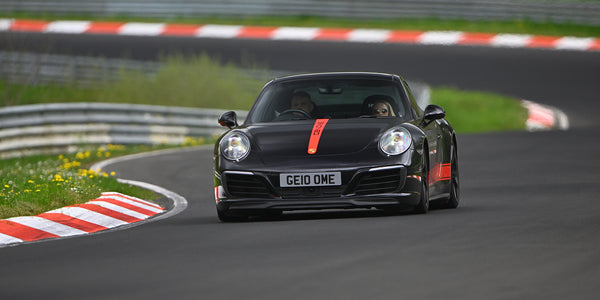
The best results come when power and control are developed as one. Our Porsche tuning packages add usable torque and power. Our chassis work makes sure you can deploy it. When we took our GD480 911 to the Nürburgring, the setup was just as important as the remap.
Power is nothing without control. We look after both.

Book a Porsche string alignment and flat floor setup, or talk to us about Suspension Secrets upgrades for your car.
CONTACT THE GENOME TEAMOur Porsche specialist workshop is located conveniently for Leeds, York, Harrogate and North Yorkshire.
Porsche Alignment FAQs
What's the difference between wheel alignment and geometry?
Alignment usually means setting toe so the wheels point straight. Geometry, or a geo setup, covers every setting that decides how the tyre meets the road: camber, caster, toe, ride height, bump steer and corner weights. A performance setup adjusts all of them together.
What is a Porsche GT4 or GT3 string set up?
It's a full geometry setup measured with string lines set parallel to the car's centreline, rather than an alignment machine. On GT4 and GT3 models we combine it with corner weighting on our flat floor, setting camber, caster, toe and ride height for fast road or track use.
Why is string alignment more accurate than a laser alignment machine?
String alignment measures each wheel directly against the car's own centreline, with no clamps or targets in between. It's done on a level flat floor with driver weight in the car, and lets us set ride height, corner weights, camber and toe together in one process.
How much negative camber can a Porsche GT4 or GT3 run on track?
On factory hardware a GT4 tops out at around -2.4 degrees at the front and a 992 GT3 RS at -2.8 degrees. With Suspension Secrets top mounts a GT4 can run well beyond -3.5 degrees, and their 992 GT3 RS camber blocks allow up to -4.0. The right figure depends on your tyre, circuit and driving, so we set it by reading tyre wear and behaviour.
Can I get more camber without fitting new parts?
Often a little, by using the full factory adjustment range and setting ride height correctly. On GT4, GT4 RS and 992 GT3 RS models you'll hit the limit before reaching a proper track setting, which is where Suspension Secrets top mounts, camber blocks and toe arms come in.
Will a track setup wear out my tyres on the road?
A full track setup with lots of camber can wear the inner edges on long motorway runs. That's why we offer a separate fast road setup, which improves grip and feel while staying kind to tyres in everyday driving.
What is corner weighting and does my road car need it?
Corner weighting balances the car's weight across the four tyres with the driver on board. A balanced car turns the same left and right and brakes straight. It matters most on track cars and lowered cars, but even standard road cars can show surprising imbalances.
Do I need a setup after lowering my Porsche or fitting new suspension?
Yes. Lowering changes camber, toe and bump steer, and new springs or coilovers change ride height and corner weights. Any suspension change should be followed by a full setup.
How often should a track car's alignment be checked?
At least once a season, and after any kerb strike, off, or suspension work. If the car starts pulling, feels different left to right, or wears tyres unevenly, get it checked sooner.
Does Genome set cars up to factory specification?
We can, but most owners come to us for something better suited to how they drive. Working with Suspension Secrets, we've developed our own fast road and track specifications rather than relying on the factory figures for the car's registration.
Where can I get a Porsche string alignment in Yorkshire?
At Genome Design. Our Porsche specialist workshop is located conveniently for Leeds, York, Harrogate and North Yorkshire. We string align and corner weight Porsches on our levelled flat floor, and fit the full Suspension Secrets range.